2009 will most likely be remembered as the year that the Internet expanded beyond the tech set as more people flocked to the web to search and share information — largely due to the growth of social media and the rapid advancements in mobile handheld technology.
Whether in news, entertainment, sports or politics, just about everyone launched a Twitter account this year. At the time of this post, Ashton Kutcher topped the list with 4.2 million followers with Britney Spears, Ellen DeGeneres, Barack Obama, Oprah Winfrey, John Mayer, CNN, Twitter, Ryan Seacrest and Kim Kardashian rounding out the Top 10 Twitter users.
Facebook, with 350 million users, was the top search term in 2009 and hit #1 for the first time as the most visited site in the U.S. on Christmas and Christmas Eve.
Well, sort of. I started using Hootsuite, a web based Twitter app, in mid-April 2009. I like many of the site’s features, especially the ability to schedule tweets, manage multiple social media accounts, monitor keywords and track link stats via their propietary URL shortener ow.ly. Get it? Hoot as in “owl.” Pretty clever and just as effective as bit.ly, though I use that occasionally, as well.
At any rate, I have become pretty reliant on Hootsuite and use it almost exclusively when tweeting from my desk. When on Blackberry, I use ÜberTwitter which also offers built in bit.ly URL shortening functionality.
Basically, I was curious to see which of my tweets generated the most interest in 2009. The challenge, however, comes in determining how to measure that. The closest I can estimate is by looking at those with the most clicks.
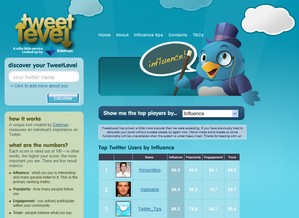
This week, Edelman released TweetLevel, the latest web-based tool designed to measure one’s “importance” on Twitter.
For those who haven’t given in to peer pressure to join the site yet, Twitter is a “microblog” that enables users to share thoughts, activities and news via 140 character text updates.
Twitter’s founders had a pretty basic, yet novel idea. They wanted to create a platform where users could connect with each other online to answer one simple question, “What are you doing?”
I’ll admit that when I first joined (@almacy), I just didn’t get it. Besides a few close family members and friends, I remember thinking, “Who really cares what I’m doing?” In fact, my first tweet isn’t exactly going to assist in solving global strife.
This past weekend, the Associated Press reported that the White House was moving to an open source content management system (CMS) known as Drupal. Many among the tech set have praised the move including Nancy Scola from techPresident who was among the first to write about the change in her post, WhiteHouse.gov goes Drupal. A good read.
For those not familiar with what this actually means, a CMS is basically the back-end (not visible to visitors) of a website that allows the administrators (owners) of the site — often non-programmers — to easily organize site navigation and add content designed to appear on the front-end.
For most CMS solutions, the user experience is pretty simple, usually consisting of a password protected login, options for varied user permissions for approval and forms with specific fields based on type of content such as text, photos, audio and video. Once entered and saved, the CMS stores the information in the back-end database and displays the content on the front-end when called up by a site visitor.
Traditionally, August is supposed to be a little quieter in Washington, DC. Not so this summer with the current debates heating up over the future of the US economy, bailouts, healthcare reform and energy legislation.
The Internet is certainly playing a key role. In fact, YouTube may have officially reached its digital advocacy “tipping point” when a handful of videos were recently uploaded featuring flustered politicians struggling to answer tough healthcare questions during several Congressional town hall meetings.
Many Democrats in support of the bill have moved to characterize opponents as an organized, astroturfing, angry right wing mob. House Speaker Nancy Pelosi (D-Calif.) even went so far as to call the protests “un-American.” On the contrary, it was the SEIU who was caught on tape beating a black conservative who voiced dissent over the plan.
Chalk up another Internet success for Campaign 2008 as users continue to generate content aimed at moving minds and generating online buzz for Presidential candidates in their bid for the White House.
This time, Will.i.am from Black Eyed Peas fame, created a music video based on Senator Barack Obama’s speech after his loss to Sen. Hillary Clinton in the New Hampshire primary.
The catchy and inspiring song, entitled “Yes We Can” officially lives at Dipdive.com, and features a number of celebrities from sports, stage, music, television and film.
It’s almost impossible to fight back a smile when Vince Vaughn and Owen Wilson go at it in the “lock it up” reception scene in the 2005 comedy smash hit Wedding Crashers.
However, what Network Solutions is doing is no laughing matter. The domain registration mega-site has recently started a new practice which is – well, in my opinion, un-American!
Have you ever tried to purchase a domain name? It’s really pretty easy and there are a number of web based registration choices out there such as GoDaddy, Register, MyDomain and, of course, Network Solutions.
The first basic step is to visit one of these sites and search to determine if your domain name is still available. Chances are that someone out there may have had the same idea and beaten you to the punch.
Last night hundreds of Washingtonians braved a cold and wet wintry mix to attend a reception hosted by Google as they unveiled their new DC office space. Although Google has been in Washington for some time, occupying temporary offices on Penn Ave, this move is significant primarily because it further evidences the search giant’s commitment to establishing a stronger, more permanent presence in the nation’s capital.
The New York Ave location is home to approximately 15 Googlers for now – with ample room to expand. In keeping with Silicon Valley style, the space itself looks more like the Googleplex in Mountain View, rather than a traditional, stodgy law firm which is a welcome departure – and an indication that times, they are a changin’!
Individual work areas are complete with colorful yoga balls, curved desks and open air studio celings. Various other meeting spaces including conference rooms, a game room lunch room and kitchen bear names familiar to the DC power set such as the Situation Room, Camp David, and even, yes, a Secret Undisclosed Location - which isn’t too secret considering the bold-lettered sign by the door.
Google CEO Eric Schmidt attended the event, as well as members of Google DC’s leadership team including Alan Davidson, senior policy counsel, Dr. Vint Cerf, chief Internet evangelist, and Bob Boorstin, corporate communications.
RT @ggreenwald: Good to see so many progressives taking the principled stance on the DOJ's dangerous attack on Fox's James Rosen http://t.c…
Time ago 1 Dayvia Twitter for iPhone